
The architectural perspective brought forward here, is suggesting a vector of experience by articulating the exhibiting space, its hosted artwork, and the human…
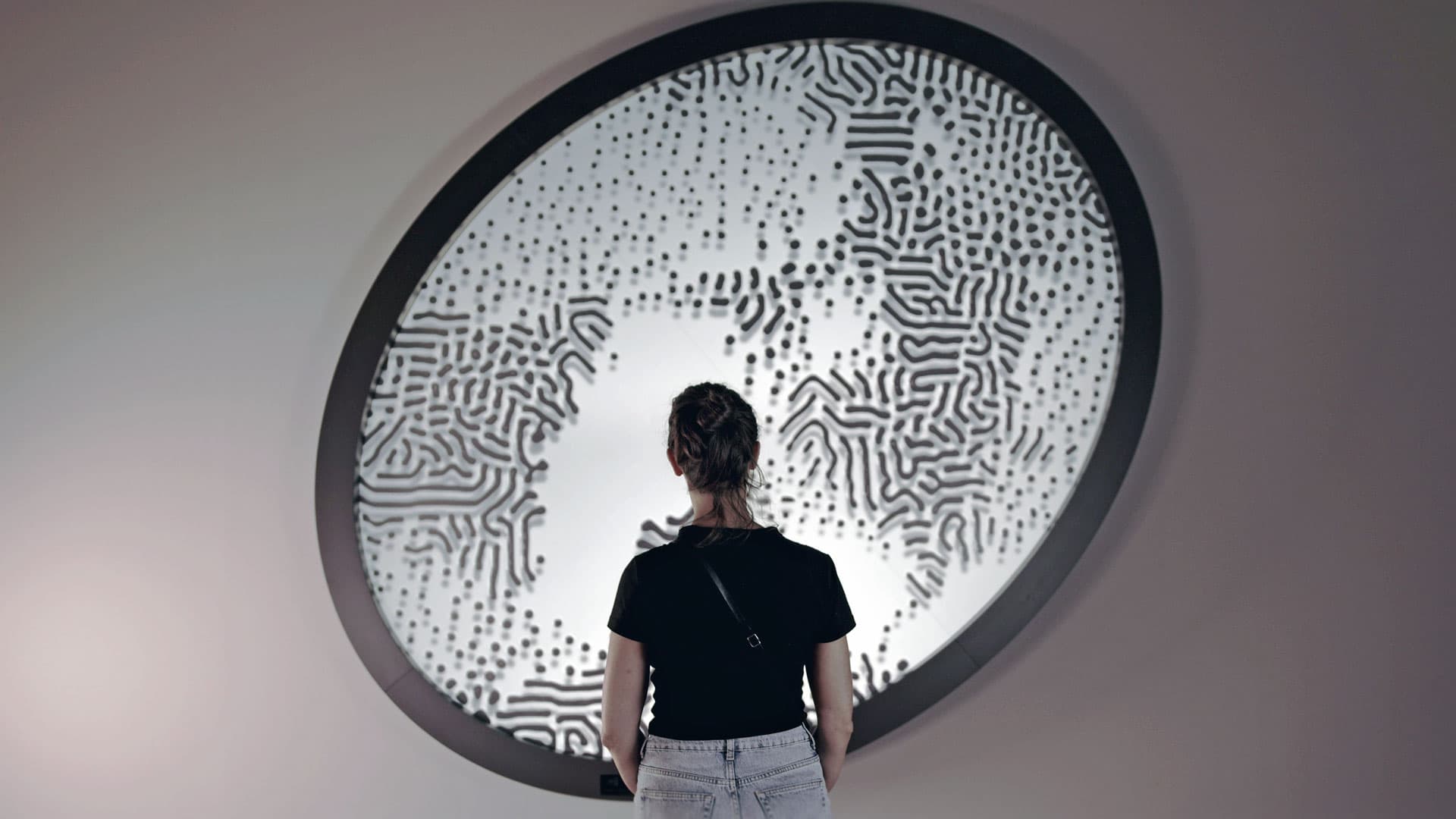
Proteus is a collaborative project continuously evolving as a series of mixed-media interactive installations integrating human and machine intelligence to interact with organic material behaviour, digital modulation, and human perception. A common material vector to the series gathers the unique characteristics of ferrofluid — a colloidal material that dynamically alters its shape under magnetic influence — to evoke an elemental, elusive presence akin to the ancient god Proteus, a foretelling deity reappraised and characterised anew throughout digitised communication. As Proteus shifts between forms to evade truth, it becomes a contemplative meditation on change, unpredictability, and the vast unknown. This behaviour speaks to the universal myth of the desire to understand and categorize phenomena that resist stable form.
The architectural perspective brought forward here, is suggesting a vector of experience by articulating the exhibiting space, its hosted artwork, and the human body. Suspended in mid-air, framed by, or applied against architectural elements depending on its exhibiting conditions, the display takes the shape of an oval of architectural proportions. This oval form recalls its historical significance in late Baroque to evade monocentric and radial designs, and relates to the organic sources of the visual imagery being displayed. Such spatial articulation, size and shape then provokes a monolithic and elemental response in bringing an interaction inside the walls of an exhibiting institution, and projecting the far-distanced natural world into that space. Historically, this role was assumed by the presence of an oculus in a building. From its fundamental use in Renaissance and Baroque architectures by piercing the thick layers of a wall or ceiling to bring into space the skies with their secular temporalities; from Paladio’s Pantheon, to Borromini’s Palazzo Barberini, and through the modern planarizations of Marcel Breuer in the walls of the NY MET Museum, Proteus’ body feeds from this legacy and transforms its former laboratory display into an architectural oculus. Proteus 3.0 is an interactive and generative video installation which, once in place within the walls of its exhibition and switched on, remains in conversation with its audience and learns from the visual attention it can get to produce new potentially meaningful sequences of images. Until the end of its exhibition, when it is switched off and set frozen in time. By then, its last learned state is saved and becomes the new generative beginning for its next exhibition. The learning and interactive process continues endlessly during the artwork’s lifetime for each exhibition and conditions its existence. Its generative imagery remains open-ended and its content to be modulated by its beholders. Just like Interacting With a Cloud..
Proteus 3.0 is an interactive and generative video installation which, once in place within the walls of its exhibition and switched on, remains in conversation with its audience and learns from the visual attention it can get to produce new potentially meaningful sequences of images. Until the end of its exhibition, when it is switched off and set frozen in time. By then, its last learned state is saved and becomes the new generative beginning for its next exhibition. The learning and interactive process continues endlessly during the artwork’s lifetime for each exhibition and conditions its existence. Its generative imagery remains open-ended and its content to be modulated by its beholders.
View from a distance of the installation as exhibited for Biomedia, ZKM Karlsruhe, 2021.
Series: Proteus
Version: 3.0
Title: Interacting With a Cloud
Year: 2021
Type: Interactive and Generative Installation
Authors: CompMonks, Maria Smigielska
Dimensions / Format: 350 x 350 x 30 cm, 4K - 3840 x 2160 px
Materials: Backlit projection mapped from 2 video projectors on a lenticular black screen, custom wooden frame, acrylic paint, Kinect camera, reinforcement learning.
Funding: the Digital Culture Programme of the Kulturstiftung des Bundes, the Beauftragte der Bundesregierung für Kultur und Medien. Co-funded by “BioMedia” ZKM.
Production: Created as part of the intelligent.museum project at ZKM and the Deutsches Museum
Collaboration: ZKM Center for Art and Media - Production collaboration
Exhibitions: The Intelligent Museum is Around the Corner (ZKM Center for Art and Media, 2023),Biomedia, The Age of Media with Life-like Behavior (ZKM Center for Art and Media, 2021)
Acquisitions: Art of The 20th and 21st Century (ZKM Center for Art and Media, 2022)
©CompMonks, Maria Smigielska