
The work is exhibited as an interactive and generative installation within the open volume of a cube cutout from a virtual space. Two walls and a floor are…
Dreamcatcher is a series that investigates the relationship between writing and memory through the prism of digitised dreams, seeking to expose their content to the awakened experience. By materialising personal dream recollections and their aesthetics over an extended period, the project is a continuous research punctuated by mixed-media installations progressively shedding light on mythologies of the transient and liminal. Three questions motivated the project: How can we represent something so elusive that we can only recollect in parts and brief moments? How can we make such an uncertain thing tangible while preserving its polysemy? Can we get more objective sources than their narrations? The interesting aspect of such questions, in both artistic and scientific views, is the tension between our scientific knowledge that establishes strong beliefs about the capacities of the human mind and the desire to deal with the bits that elude representation. Rebuilt with AI in 4 dimensions from brain and semantic data collected during my active sleep sessions and their awakened recollections, oniric landscapes, objects, and characters emerge to reveal this unknown of our lives and its role in human creative capacities. By materialising them, fleeting memories become tangible and make it possible to be re-experienced fully awake, within the aesthetic veil of the Pittoresque and how it deals with spatial compositions and sensible experiences.
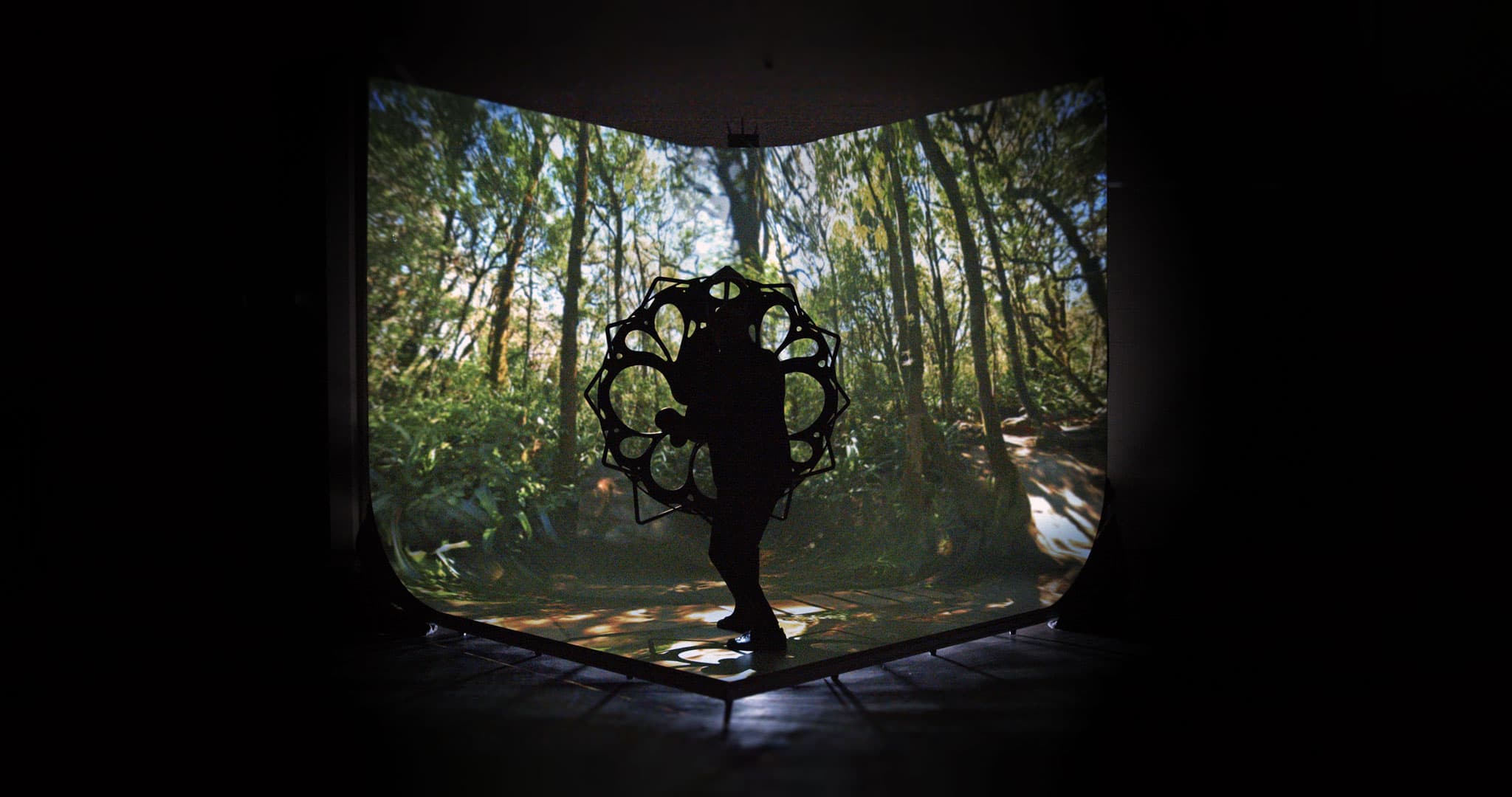
The work is exhibited as an interactive and generative installation within the open volume of a cube cutout from a virtual space. Two walls and a floor are joined to form a corner-screen that delineates itself from the surroundings and blurs its internal limits. The inner surfaces serve as a continuous projection screen where the generated landscapes of the dreams are displayed and synchronised with a shield-mask integrating a VR headset that visitors can wear and enter the installation to re-enact the exploration of the dreams. As the installation sits at The Gates of The Fleeting, where dreams take shapes in the eye to vanish in the mind, venturing into that liminal world demands caution. The shield-mask is an explorative periscopal instrument that provides protection and controlled sight to the awakened. These two artefacts compose the installation; the corner-screen and the shield-mask form an entrance and its means of access. This is the first gate among many more to be found in that world, leading to the well-guarded depths of our minds across the mythical Belt of the Bright Night, a sun-guarded arc of ancient digital gates.
A gate one cannot pass as its projections already need protection from, and peeking at what lies beyond already alters it. The corner-screen is made to be walked on to ease its approach. But actively interacting with it demands to wear the shield-mask. The Gate of The Fleeting was the first one to appear. As best as I can recall, it was whispered to me by the same presence as the one who whispered the shield mask in a dream. It said this gate was not the only one, and they should be practised with great caution once discovered. Little did I know then to take a whisper as a shouting word of wisdom.
Overall view of the interaction with the corner-screen and the shield-mask.
Series: Dreamcatcher
Version: 0.0
Title: Walking The Gates of The Fleeting
Year: 2023
Type: Interactive and Generative Installation
Authors: CompMonks
Dimensions / Format: 300 x 300 x 300 cm, 3x 4K - 3840 x 2160 px.
Materials: Aluminium modular structure, plywood panels, 3D printed nylon, resin and acrylic paint, computer, UHD short throw projectors, VR headset, neural and semantic data, custom representation learning.
Funding: Académie des beaux-arts Paris, CAAD ETH Zürich
Production: CompMonks, DBT ETH Zürich
Collaboration: Digital Building technologies - Production collaboration,ETH Zürich - Scientific collaboration
Exhibitions: Emulations (French Institute, 2023)
Awards: Charles Abella Prize (Académie des beaux-arts, Mention)
©CompMonks, Photo: CompMonks, Thierry Serbeto